
Resistor Color Code Chart
The colour table and the reading method below come from the DersTeders article on resistor colour codes and the electronics workshop material. Values are not filled in from memory.
- 12 colour rows
- Digit, multiplier and tolerance roles
- 2 worked examples from the site
- 4-band and 5-band reading rules
Colour to digit chart
The first bands are read as digits. Gold and silver are used for the multiplier and the tolerance band instead of a digit.
| Band colour | Digit | Other documented use |
|---|---|---|
| Black | 0 | — |
| Brown | 1 | — |
| Red | 2 | Also used as a x100 multiplier |
| Orange | 3 | Also used as a x1000 multiplier |
| Yellow | 4 | — |
| Green | 5 | — |
| Blue | 6 | — |
| Violet | 7 | — |
| Grey | 8 | — |
| White | 9 | — |
| Gold | No digit | Multiplier 0.1; tolerance ±5% |
| Silver | No digit | Multiplier 0.01; tolerance ±10% |
How to use this reference
Find the tolerance band first. It is usually gold or silver and sits at the right-hand end, so you know which side to read from.
Read the first two bands as digits from the left, then use the third band as the multiplier. Our guide says to append zeros, or multiply by 0.1 or 0.01 for gold and silver.
Worked example from our article: brown, black, red, gold. The first two bands give 10, red is a x100 multiplier, so 10 x 100 = 1000 Ω = 1 kΩ with ±5% tolerance.
Second example from the electronics workshop: red, red, orange, gold. The digits give 22, orange multiplies by 10³, and the result is 22 kΩ with 5% tolerance.
A five-band resistor is read differently: the first three bands are digits, the fourth is the multiplier and the fifth is the tolerance.
Related DersTeders pages
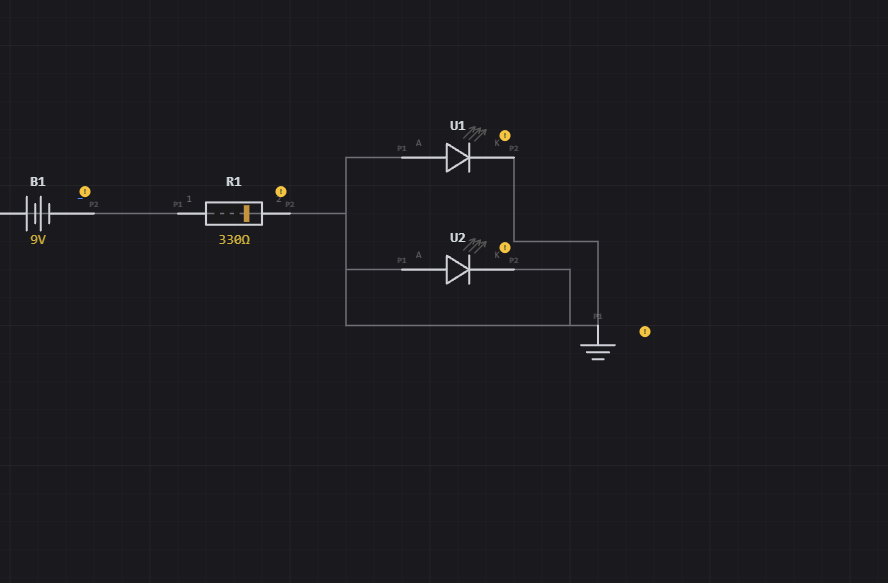
Full colour-code articleThe source article with the step-by-step reading method.Choosing the series resistorWork out the resistor value for an LED circuit.Circuit simulatorTry the calculated value in a browser circuit.Keep the reference close. Create a free account to save your place, open the simulators and follow the full electronics guides.
Save your circuitFrequently asked questions
Which band is read first?
The tolerance band is usually on the right, so start at the opposite end and read the digit bands from the left.
What happens with five bands?
On a five-band resistor the first three bands are digits, the fourth is the multiplier and the fifth is the tolerance.
What do gold and silver mean?
As multipliers they mean 0.1 and 0.01; as tolerance bands they mean ±5% and ±10% respectively.
How do I check my reading?
Switch off power before measuring and confirm a faded or uncertain value with a multimeter, as our guide recommends.
Interactive circuit guide
Run the simulation, follow the build steps one by one and try it in our real app.
 Stopped
Step-by-step build