
Wire Gauge Basics
Our sources explain how to size a conductor from current, cross-section and voltage drop. They do not contain an AWG-to-diameter table, so no gauge numbers are listed.
- 8 documented sizing rules
- Area, current and voltage-drop formulas
- Fuse selection example
- No invented AWG values
Conductor sizing rules in our material
These are the documented relationships used in the electrical installation lessons.
| Quantity | Documented rule | What it is used for |
|---|---|---|
| Cross-section area | S (mm²) = pi x diameter² / 4 | Finding the area from a measured wire diameter |
| Current and size | The more current a cable must carry, the larger the required cross-section | Choosing a conductor for the load |
| Current | I = P / V | Finding the current from power and voltage |
| Voltage drop | dU = 2 x I x L x rho / S | Checking a long cable run against a drop limit |
| Fuse and cable | The fuse value must not exceed the cable current capacity | Protecting the conductor, not only the device |
| Worked fuse example | A 5 A motor uses a 7.5 A fuse in our example | Fuse chosen above normal current but below fault current |
| Conduit choice | Conduit diameter depends on the number and cross-section of cables | Mechanical protection and installation |
| Measurement safety | Cut the energy and verify before working on a conductor | Safe installation practice |
How to use this reference
Start from the load. Our installation material gives current as I = P / V, so the power and voltage of the load determine the current the wire must carry.
Relate diameter to area with S = pi x diameter² / 4. This is the rule our source uses when a cross-section in square millimetres is needed.
Remember the size rule stated in our material: as the current a cable carries increases, the required cross-section area increases as well.
Check long runs with the voltage-drop relation dU = 2 x I x L x rho / S. A thinner or longer cable drops more voltage.
Choose protection to match the cable. Our worked example selects a 7.5 A fuse for a motor drawing 5 A, while reminding that the cable capacity must not be exceeded.
Before any connection work, isolate the circuit and verify that it is de-energised, as our safety pages require.
Related DersTeders pages
Switching and voltage dropThe source for the voltage-drop relation.Main distribution linePower, cross-section and protection together.Circuit safetySafe working rules before you touch a conductor.Keep the reference close. Create a free account to save your place, open the simulators and follow the full electronics guides.
Topic trackingFrequently asked questions
How do I find cross-section from diameter?
Use S = pi x diameter² / 4, with the diameter measured in millimetres and S in square millimetres.
Does a longer cable need a larger cross-section?
Voltage drop grows with length in the rule dU = 2 x I x L x rho / S, so a long run may need a larger conductor.
How is the fuse value chosen?
Our example uses a 7.5 A fuse for a 5 A motor. The guide also says the fuse must not exceed the cable current capacity.
Where is the AWG table?
Our source material does not include one, so this page does not invent gauge-to-diameter values.
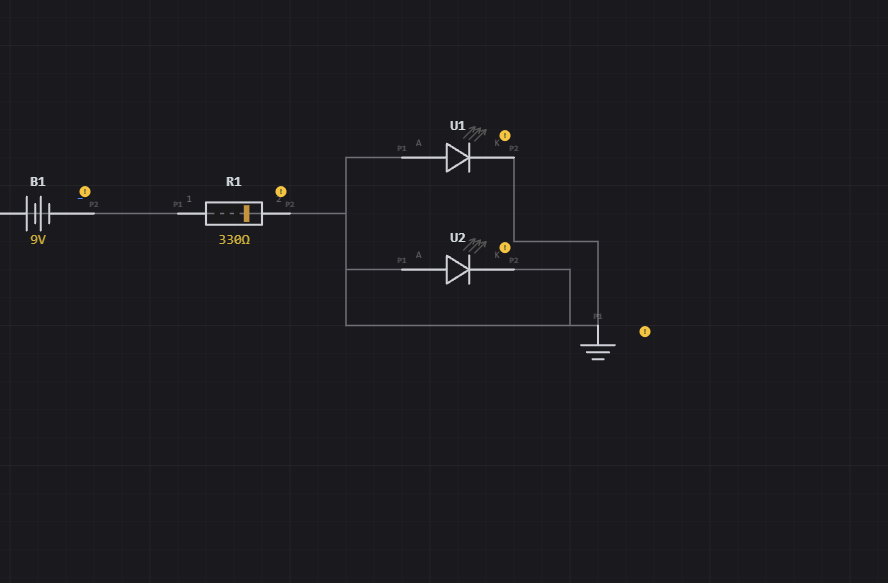
Interactive circuit guide
Run the simulation, follow the build steps one by one and try it in our real app.
 Stopped
Step-by-step build